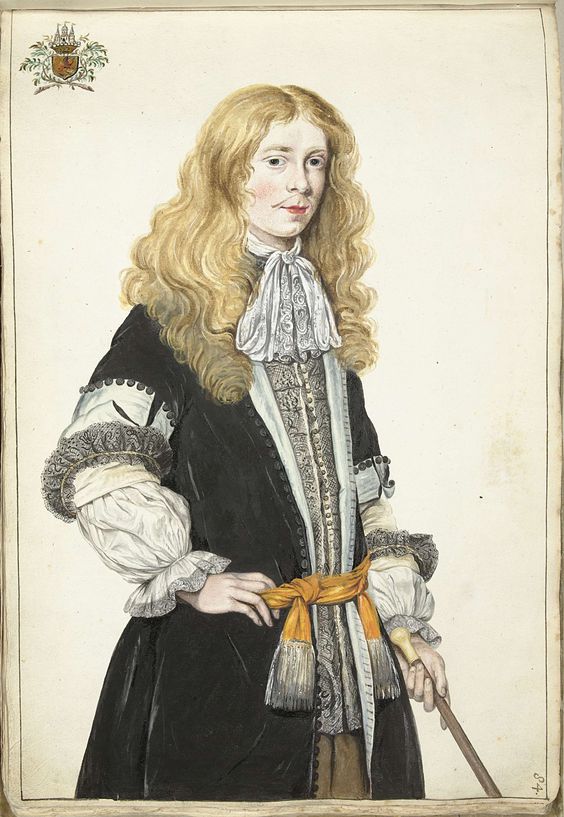
oil on canvas,
h 76.2cm × w 56.5cm.
More details
The two painters produced this portrait to commemorate their
youngest brother, Moses, who was born
in 1645. Moses died in 1667 during the storming of Fort Landguard near
Felixstowe in England. He had served in the Dutch navy against the
English since 1664. In the painting Moses is surrounded by symbols that
allude to his military life: time (the pocket watch), death (the skull),
eternity (the ivy on the rocks) and loyalty
(the dogs).
Showing posts with label Anglo-Dutch Wars. Show all posts
Friday, 30 August 2019
Saturday, 8 July 2017
Saturday, 1 July 2017
Lord High Admiral's Regiment by Ralph Mitchard
2nd July 1667 Duke of York and Albany's Maritime Regiment - defence of Landguard Fort 350 years ago tomorrow.
Tuesday, 28 October 2014
Tuesday, 22 July 2014
Monday, 10 December 2012
Friday, 31 August 2012
Thursday, 30 August 2012
More New "Goodies" From North Star 1672
| The Duke of Monmouth mounted and young Mr. Churchill on foot |
| Armored Cavalry Command |
| Cavalry in breastplate with 3-bar helmet |
Following on to Ralphus' last post on this range, and for those that may have missed it on TMP, Nick at North Star has announced that sculptor Steve Saleh has been very busy of late.
The photo captions are self-explanatory, with the possible exception of the personality figures of Monmouth and Churchill. I commented to Nick that the appearance of young Mr. Churchill was a bit "dodgy", as it doesn't conform to his uniform with the Lord High Admiral's regiment or the French-issued uniforms he would have worn with either the 2nd Battalion of the Royal English regiment or the later French Royale Anglais. Nick has responded that he agrees, in principle, but that Steve based the sculpt on a sketch of young John in one the many biographies. With his reminder, I vaguely remember the sketch, but can't place the book; I'll have to dig through my collection. At any rate, Nick felt that it would be a unique and interesting sculpt to add to the range, which I can't disagree with, and that there were already plenty of officer and ensign castings that could work for Mr. Churchill in proper uniform.
The Armored Cavalry Command appear excellent. The Cavalry in breastplate are very good for what they are, namely Maritime Alliance English, Dutch or Germans. I would hope that Steve and Nick would turn their attention to some proper Austrian or Imperial Cuirassier for the Rhineland Campaign and the Italian Campaign, as these would be very useful figures. He could base the sculpts on these illustrations as a starter:

The distinctive Austrian helmet with the adjustable nasal would be nice to see, as would the full back & breast. Hint, hint Nick and Steve, Christmas is coming you know!
Til next;
Bill
Tuesday, 31 January 2012
Williamite conference
Thanks to Rampjaar 1672 for this:
The Williamite Universe co-organises an upcoming conference in Maison française d’Oxford, 3-4 May 2012, entitled
“Louis XIV: Outside In: Reactions and Responses to the Sun King beyond France.”
The conference map the variety of ways reactions to Louis shaped discussion and action across Europe and the globe; and will provide a forum for stimulating comparative history.
Plenary speakers include:
Professor Tim Harris (Brown, Providence RI, US),‘Francophobia in late Stuart England’
Professor David Hayton (Queens, Belfast, UK), ‘Louis XIV, James II, and the conflict in Ireland’
Professor Henk van Nierop (Amsterdam, NL), ‘Romeyn de Hooghe’s Louis XIV’
Professor Hendrik Ziegler (Hamburg, D),‘Image battles under Louis XIV’
For more information, check the conference website:
http://www.bangor.ac.uk/history/conferences/louisXIV/index.php
or the Williamite Universe website:
http://www.let.uu.nl/ogc/William/
or contact the organisers
Tony Claydon (t.claydon@bangor.ac.uk) or Charles-Edouard Levillain (charles-edouard.levillain@iep.univ-lille2.fr)
Best wishes,
WU secretary
The Williamite Universe co-organises an upcoming conference in Maison française d’Oxford, 3-4 May 2012, entitled
“Louis XIV: Outside In: Reactions and Responses to the Sun King beyond France.”
The conference map the variety of ways reactions to Louis shaped discussion and action across Europe and the globe; and will provide a forum for stimulating comparative history.
Plenary speakers include:
Professor Tim Harris (Brown, Providence RI, US),‘Francophobia in late Stuart England’
Professor David Hayton (Queens, Belfast, UK), ‘Louis XIV, James II, and the conflict in Ireland’
Professor Henk van Nierop (Amsterdam, NL), ‘Romeyn de Hooghe’s Louis XIV’
Professor Hendrik Ziegler (Hamburg, D),‘Image battles under Louis XIV’
For more information, check the conference website:
http://www.bangor.ac.uk/history/conferences/louisXIV/index.php
or the Williamite Universe website:
http://www.let.uu.nl/ogc/William/
or contact the organisers
Tony Claydon (t.claydon@bangor.ac.uk) or Charles-Edouard Levillain (charles-edouard.levillain@iep.univ-lille2.fr)
Best wishes,
WU secretary
Wednesday, 23 March 2011
Clibinarium Has Been Busy!
Long time between posts; if only Life would stop interfering!
Our good friend "Clibinarium" has been busy plying his trade as a sculptor of late. Just announced on the Pendraken Forum are the 1st masters for their new 10mm pre-18th century range. While it will fall under the heading of League of Augsberg, it will also include several figures that will work for the earlier Franco-Dutch Wars as well (which these masters depict). This will be similar to the very inclusive and varied AWI range that Clibinarium did for Pendraken.
Pendraken Command Group - 10mm
Pendraken Assorted Musketeers - 10mm
Pendraken Assorted Pikemen - 10mm
And, in case you might have missed it, Clibinarium also did the recently released 28mm range for Barry Hilton's League of Augsberg, details of which can be found on Barry's site here, and very well-painted samples here.
All-in-all, a very good time for enthusiasts of the late 17th century and the wars of Louis Quatorze! Clibinarium is a die-hard fan of this period, does extensive research, and sculpts a pretty good figure (major understatement). So, in case you were considering getting your feet wet in this period, it might be time to start building, or raiding, that War Chest now.
Bill
Our good friend "Clibinarium" has been busy plying his trade as a sculptor of late. Just announced on the Pendraken Forum are the 1st masters for their new 10mm pre-18th century range. While it will fall under the heading of League of Augsberg, it will also include several figures that will work for the earlier Franco-Dutch Wars as well (which these masters depict). This will be similar to the very inclusive and varied AWI range that Clibinarium did for Pendraken.
Pendraken Command Group - 10mm
Pendraken Assorted Musketeers - 10mm
Pendraken Assorted Pikemen - 10mmAnd, in case you might have missed it, Clibinarium also did the recently released 28mm range for Barry Hilton's League of Augsberg, details of which can be found on Barry's site here, and very well-painted samples here.
All-in-all, a very good time for enthusiasts of the late 17th century and the wars of Louis Quatorze! Clibinarium is a die-hard fan of this period, does extensive research, and sculpts a pretty good figure (major understatement). So, in case you were considering getting your feet wet in this period, it might be time to start building, or raiding, that War Chest now.
Bill
Labels:
10mm,
Anglo-Dutch Wars,
Late 17th Century,
League of Augsberg,
wargaming
Tuesday, 25 August 2009
Chatham Defences 1667
<
In 1574 the entrance to St Mary's Creek which cuts of a bend in the Medway had been blocked by wooden piles. In the same year the need for a lookout ship on permanent patrol off Sheerness was identified and the watch established. In 1585 a chain was stretched across the Medway just below the Elizabethan Upnor castle, itself completed in 1567 and enlarged in 1601. finally, a fort at Sheerness was begun in 1666. (Asquith, MM 1986)
This is an excellent short summary of the defences along the Medway but when you start researching and visiting the site this becomes a topic in itself!
Queenborough Castle, the picture at the start of the article,was built on the isle of Sheppey by Edward III in the 1360's to defend the Kent Coast along the Swale Estuary.

Built of Stone it was a novel design for its time anticipating the centrally planned castles of henry VIII by nearly 200 years. the castle was one of the 1st to be designed to withstand cannon fire. Looking at its plan it would have been difficult to storm.

The attackers would have to cross the moat, breech the outer gate, force the inner gate, pass halfway around the outer ward while being exposed to heavy fire from above, force another inner gate and then penetrate the Rotunda gate leading to the living quarters which were completely compartmentalised. No easy task!!
The importance of the castle declined with the decline of the River Swale as a shipping route. The castle was declared obsolete in 1650 and demolished soon after. The loss of this very defendable fortress was badly felt when the Dutch attacked and landed on the isle of Sheppey just 17 years after the castles destruction and before adequate defences had been completed at Sheerness.
Nothing now remains above ground of Queenborough Castle the site now a park and childrens play area but what of the Garrison at Sheerness? why did it fall so quickly. Well as mentioned the fort was only begun in 1666.
Here is an excerpt from 'The ville of Sheerness', The History and Topographical Survey of the County of Kent: Volume 6 (1798)which describes the poor defences at Sheerness and the Medway as a whole and the king visiting personally Sheerness to establish a 'Royal Fort'
'The king took this charge upon himself, and in the beginning of the year 1667, made two journeys hither in the depth of winter, taking an engineer and some officers of the ordnance with him, and having seen the work begun, he left at it his chief engineer Sir Martin Beckman, whom he designed for governor of the fort, and committed the overlooking of the whole, that every expedition might be used, to one of the commissioners of the ordnance; notwithstanding which, very little or nothing had been done towards it, when the Dutch, that year, made their memorable attempt upon the royal navy in the river Medway, which was then in a most defenceless state, there being at that time, besides the twelve guns here as before mentioned, only four that could be used at Upnor, and scarce so many at Gillingham, for the defence of it.

From the excellent web site 'Fortified Places' which provides information on bastioned fortifications, primarily the work of Vauban and his contempories:
'In 1666 the engineer Sir Bernard de Gomme (The Dutch-born engineer Sir Bernard de Gomme was responsible for the majority of fortification works undertaken by Charles II of England. Having served under Charles I in the Civil War, de Gomme was knighted and given a promotion when the monarchy was restored in 1660)was sent to Sheerness to review the fortifications. He designed a simple square bastioned fort to enclose and strenghten the existing blockhouse and earthworks.
In 1667, the Dutch fleet sailed up the Medway, landing troops to capture the unfinished fort at Sheerness on the way. The Dutch took supplies, ammunition and guns, then burned everything that was combustible and moved upriver to attack the fleet at Chatham.
Following the destruction caused by the Dutch raid, the fortifications at Sheerness were remodelled according to new plans drawn up by de Gomme, which may date from before the raid, but cannot have progressed very far by that stage.

Of de Gomme's 17th century fort only a few bits of Portland stone are visable now along the eastern side and these are in poor condition.

The view from the beach in front of the fort which the Dutch attacked at the mouth of the Medway. I can recommend a visit to Sheerness if you are interested in military fortifications, the Victorian and WW2 emplacements on top of the old Sheerness fort protecting what was then a naval dockyard are quite impressive as good as any examples on the channel islands my Photo's of which I will post on Victory V today as these are not relevant here.

In 1574 the entrance to St Mary's Creek which cuts of a bend in the Medway had been blocked by wooden piles. In the same year the need for a lookout ship on permanent patrol off Sheerness was identified and the watch established. In 1585 a chain was stretched across the Medway just below the Elizabethan Upnor castle, itself completed in 1567 and enlarged in 1601. finally, a fort at Sheerness was begun in 1666. (Asquith, MM 1986)
This is an excellent short summary of the defences along the Medway but when you start researching and visiting the site this becomes a topic in itself!
Queenborough Castle, the picture at the start of the article,was built on the isle of Sheppey by Edward III in the 1360's to defend the Kent Coast along the Swale Estuary.

Built of Stone it was a novel design for its time anticipating the centrally planned castles of henry VIII by nearly 200 years. the castle was one of the 1st to be designed to withstand cannon fire. Looking at its plan it would have been difficult to storm.

The attackers would have to cross the moat, breech the outer gate, force the inner gate, pass halfway around the outer ward while being exposed to heavy fire from above, force another inner gate and then penetrate the Rotunda gate leading to the living quarters which were completely compartmentalised. No easy task!!
The importance of the castle declined with the decline of the River Swale as a shipping route. The castle was declared obsolete in 1650 and demolished soon after. The loss of this very defendable fortress was badly felt when the Dutch attacked and landed on the isle of Sheppey just 17 years after the castles destruction and before adequate defences had been completed at Sheerness.
Nothing now remains above ground of Queenborough Castle the site now a park and childrens play area but what of the Garrison at Sheerness? why did it fall so quickly. Well as mentioned the fort was only begun in 1666.
Here is an excerpt from 'The ville of Sheerness', The History and Topographical Survey of the County of Kent: Volume 6 (1798)which describes the poor defences at Sheerness and the Medway as a whole and the king visiting personally Sheerness to establish a 'Royal Fort'
'The king took this charge upon himself, and in the beginning of the year 1667, made two journeys hither in the depth of winter, taking an engineer and some officers of the ordnance with him, and having seen the work begun, he left at it his chief engineer Sir Martin Beckman, whom he designed for governor of the fort, and committed the overlooking of the whole, that every expedition might be used, to one of the commissioners of the ordnance; notwithstanding which, very little or nothing had been done towards it, when the Dutch, that year, made their memorable attempt upon the royal navy in the river Medway, which was then in a most defenceless state, there being at that time, besides the twelve guns here as before mentioned, only four that could be used at Upnor, and scarce so many at Gillingham, for the defence of it.
From the excellent web site 'Fortified Places' which provides information on bastioned fortifications, primarily the work of Vauban and his contempories:
'In 1666 the engineer Sir Bernard de Gomme (The Dutch-born engineer Sir Bernard de Gomme was responsible for the majority of fortification works undertaken by Charles II of England. Having served under Charles I in the Civil War, de Gomme was knighted and given a promotion when the monarchy was restored in 1660)was sent to Sheerness to review the fortifications. He designed a simple square bastioned fort to enclose and strenghten the existing blockhouse and earthworks.
In 1667, the Dutch fleet sailed up the Medway, landing troops to capture the unfinished fort at Sheerness on the way. The Dutch took supplies, ammunition and guns, then burned everything that was combustible and moved upriver to attack the fleet at Chatham.
Following the destruction caused by the Dutch raid, the fortifications at Sheerness were remodelled according to new plans drawn up by de Gomme, which may date from before the raid, but cannot have progressed very far by that stage.

Of de Gomme's 17th century fort only a few bits of Portland stone are visable now along the eastern side and these are in poor condition.

The view from the beach in front of the fort which the Dutch attacked at the mouth of the Medway. I can recommend a visit to Sheerness if you are interested in military fortifications, the Victorian and WW2 emplacements on top of the old Sheerness fort protecting what was then a naval dockyard are quite impressive as good as any examples on the channel islands my Photo's of which I will post on Victory V today as these are not relevant here.
Friday, 21 August 2009
The Dutch Raid up the River Medway 1667

I shall cover this raid by the Dutch against the English Men O War moored on the Medway, a handy anchorage for a fleet defending London, in a series of articles here using as a basis the October 1986 Military modelling article ‘Battles for Wargamers’ by Stuart Asquith and illustrated by the excellent and much lamented Richard Scollins.
I can also recommend the book ‘The Dutch in the Medway’ by PC Rogers published in 1970 and can be found if you are lucky in an antiquarian bookshop. I am currently reading this excellent book which is very well written and the first chapters setting the context of the Dutch struggle for independence and the development of their trading and naval power have been an easy read and very informative.
The raid was conceived by the Grand Pensionary Johan de Witt in May 1667 at a time when peace talks were underway at Breda to conclude what has become known as the 2nd Anglo Dutch war and apart from the obvious objective of destroying English ships and shore installations, the principle target being Chatham Dockyard, it would also strengthen the hand of the Dutch at the peace conference table.

Some 70-80 warships of varying sizes were to be used plus 3,000 – 4,000 troops under the command of Lt. Admiral Michael de Ruyter.

The action can be split up into ‘opening moves’ and three subsequent phases; the Attack on Sheerness at the mouth of the Medway, the action at Gillingam Reach and finally the defence of Chatham at Upnor Reach.

Next blog entry the English fleet and the first action!
Wednesday, 8 July 2009
Follow-up On Landguard 1667
After discovering the illustrations from "Armamentaria" of the Dutch Marines, my interest in the attack on Landguard Fort, as first reported by Ralphus here, has been renewed. After a bit of searching, I found a few sources that those interested in this battle may find useful.The first is from a site called "Fortified Places", which can be found here, and provided the illustration above of the Fort as it might have appeared in 1667, after Charles II improved the Fort's defences in 1666.
The article is well worth reading in its entirety as it covers the complete history of the Fort and its many "generations". However, the "meat" of the portion that concerns the 1667 attack is excerpted here:
In 1625 construction of a new fort on Landguard Point was started, in conjunction with a new battery at Harwich. It was a square earthwork fort with 4 bastions and a ditch. The fort was armed with 62 guns and could accommodate a garrison of several hundred men.
The fort was not maintained and erosion took its toll on the ramparts, but it was still garrisoned and the Parliamentarian's held it during the Civil War. In 1652 England entered into a series of naval wars with the Netherlands, placing Harwich on the front line. A dockyard grew up there in the 1650s, but Landguard Fort remained dilapidated.
During the Second Anglo-Dutch War England suffered a number of defeats and in early 1667 there were fears for the safety of the east coast. As a result the Dutch-born engineer Sir Bernard de Gomme* was sent to Harwich on an urgent mission to survey the defences and make improvements. Finding Landguard Fort in a much-decayed condition, he ordered work to be done to strengthen the fort as soon as possible.
The improvements ordered by de Gomme consisted of enlarging the bastions and restoring the slumped earthwork ramparts, as well as the construction of a "false bray", a second rampart running in front of the main rampart at a lower level, at the foot of the rampart all the way round the fort. The ditch and the false bray were revetted in brick.
*Sir Bernard de Gomme was responsible for the majority of fortification works undertaken by Charles II of England. Having served under Charles I in the Civil War, de Gomme was knighted and given a promotion when the monarchy was restored in 1660.
The next source, which I found quite interesting, was from GoogleBooks and is "The History of Landguard Fort In Suffolk" by Major John Henry Leslie, found here. This book has an excellent section on Landguard with more of a panoramic view of the fort (page 14) that matches the illustration above, except that it shows the main walls as being of either stone or perhaps sod blocks and describes the Fort as being of brick, which also matches the illustrations by Charles Stadden that Ralphus posted earlier.
Most sources agree that Landguard was built in 1628 of earthwork reinforced by wood, and that the brick works added by de Gomme in 1666 were only to reinforce the ditch and to create the lower "false" bray. While some of the Stadden illustrations could depict the hand-to-hand fighting at the lower bray, its unlikely that a gun on a naval carriage would have been positioned there. The Leslie book is an invaluable resource for anyone contemplating a model of Landguard Fort, or a game involving it, as it gives an exact breakdown by type of the 62 guns located within the Fort, along with a general treatise on guns of the period. As with all Google Books, this volume can be downloaded and saved as a pdf file, and does contain information on many other details of the Fort and its long history, including personnel and armament through the years.
For those that want to do some "serious" research in addition to the above, there is also an historical essay on the Battle of Landguard which can be downloaded from Coursework.info for £4.99 here, and an article from "The Journal on Post-Medieval Archaeology", Volume 42, Number 2, December 2008, pp.229-275, here for $39.00, that covers the recent archaeological excavations at the site down to the level of the 17th century works.
By the way, for anyone considering building a model of the Landguard Fort, there is a first-hand report in Leslie's book of the work-in-progress with references to the platte, or plans, with excellent dimensions. I worked out a quick rough calculation and in 15mm, not counting the proposed 60 foot wide ditch, it works out to about 60" square. In 6mm it would be slightly less than half that, about 29" square. This is based on actual height of typical figures, not advertised "scale". A large model to be sure, but not impossible for a club to consider for a convention demo. Alternately, you could model just the landward curtain wall and two bastions and do the majority of the actual attack by Dutch forces.
Bill
A Couple of Interesting Dutch Marine Plates

These two plates are again taken from the reconstructions by F. Smits published in "Armamentaria". These two illustrations are of Dutch Marines, the first from the Regiment de St. Amant in 1699. Here is a (probably) poor translation of the Dutch text found with the illustration here. Perhaps Motorway can correct the translation for us?
"Officer and Marine of the Regiment de St. Amant (1699-1711). In the print collection of the Army are two watercolor studies by J. Hoynck of Papendrecht of uniforms worn by the marines regiment St. Amant, named after the colonel of this unit, Philippe Claude Touroud St. Amant. This regiment had the decision on uniform clothing since the States in 1681 were started with the composition of uniforms for the army. Officers of this regiment were used most of the time. The regiment, as an expeditionary corps, participated in the campaign in Spain (a fact stated in the banner of the Marine Corps) and had to survive a bloody battle on December 10, 1710 in Villaviciosa. After return of the survivors from Spain, the regiment returned to full strength, whereupon on September 7, 1711 the regiment was converted to foot."

The second illustration is of the Marines that accompanied De Ruyter's fleet to Fort Sheerness in 1667. Again, the rough translation could probably use Motorway's assistance, the original text being found here.
"Marines or soldiers sent to the conquest of Fort Sheerness (1667). During the famous expedition to Chatham (the oldest event on the standard arms of the Marine Corps), commanded by Admiral Michiel de Ruyter, were around 800 marines, assigned to a landing at the Fort at Sheerness conquer (June 20, 1667) . A painting, probably made by J. Beer Straaten, gives a fairly detailed picture of the clothes, armaments and other equipment worn by the landing forces. Uniform clothing was in fact not evident, although the Captain was already central substance tunics and pants bought. Command (or Sergeants?) were armed with a halberd and a sword, around the body was an orange sash worn. Drummers carried drums with wooden bodies."
So, the obvious question would be, are these typical of the Dutch Marines faced by the Lord High Admiral's Maritime Regiment at Landguard Fort? The dates and their inclusion in De Ruyter's fleet for the campaign would certainly make that a possibility. Newer readers will want to read Ralphus' original post on the action here. If a connection can be established, there is excellent material now for a diorama, or even a game, of the attack on the fort.
Bill
Labels:
Anglo-Dutch Wars,
art,
drums,
Dutch Army,
Uniform Plates
Subscribe to:
Posts (Atom)